
Red Tagged Furnace: What It Means and How to Clear It
A red tagged furnace means a certified gas technician found a defect and took the appliance out of service until it's corrected. In Ontario that's a legal notice under Ontario Regulation 212/01, not a warning you can weigh up and decide about. The first thing to establish is whether the notice is Type A or Type B, because that determines whether the furnace is already locked out or whether a clock is running.
What a Red Tagged Furnace Actually Means
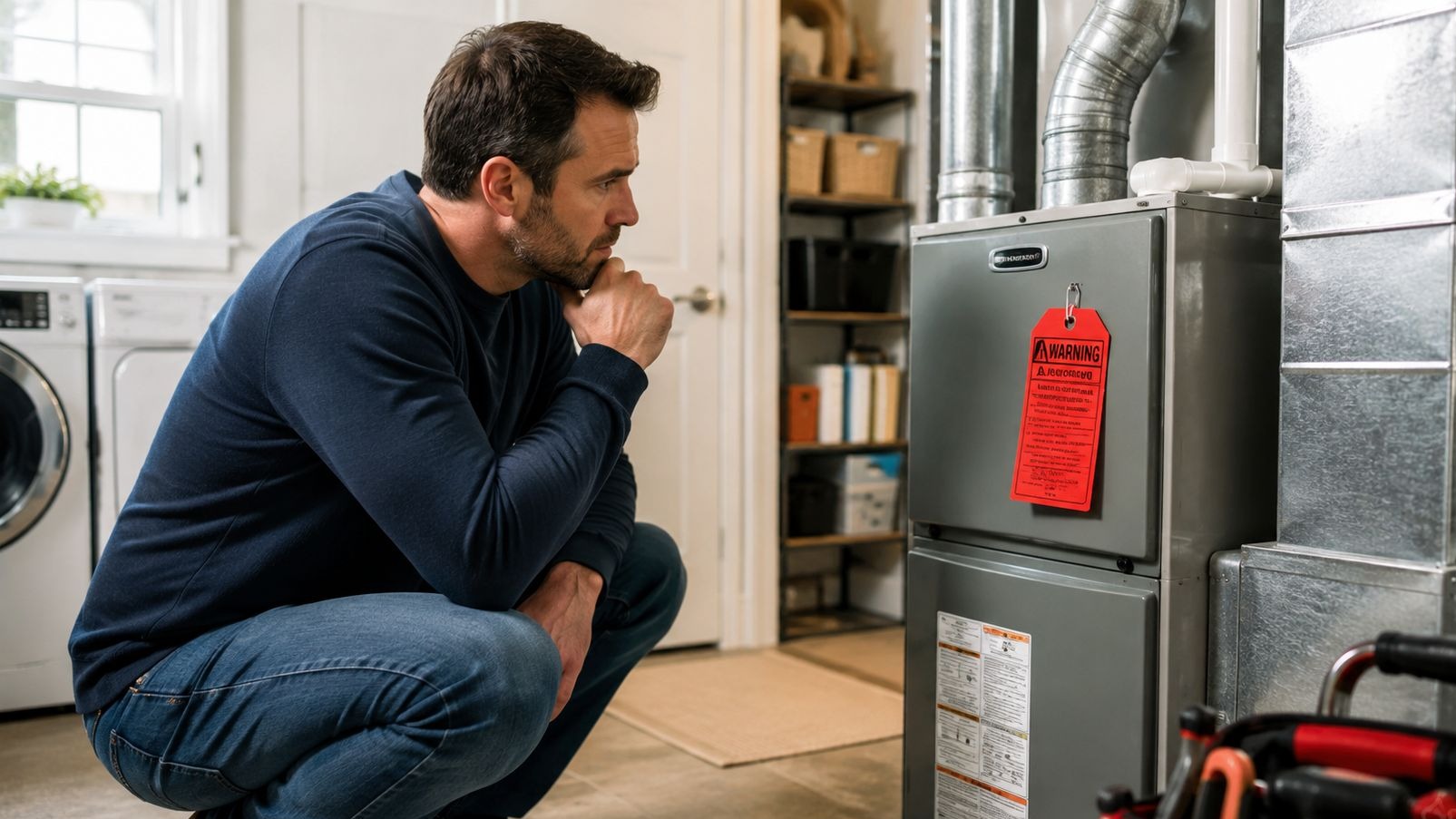
Most homeowners find the tag after the technician has already left, which makes the first question a fair one: is the furnace broken, unsafe, or both?
Under Ontario Regulation 212/01, a technician who finds what the regulation calls an "unacceptable condition" is required to act — not permitted to, required to. The regulation defines that condition broadly: an appliance used for a purpose it wasn't approved for, deterioration or alteration likely to impair safe operation, or a problem with piping, venting, combustion air supply, or clearance from combustible material.
If the technician judges that condition to be an immediate hazard, section 13 obliges them to shut off the gas on the spot. If it isn't immediate, section 14 obliges them to notify the utility and tag the appliance anyway.
That's why a red tag isn't a repair estimate and isn't the technician's opinion about your furnace. It's a statutory notice. A technician who found a qualifying defect and didn't tag it would be the one breaking the rules.
Practical rule: if the tag is on the furnace, the furnace doesn't get turned back on until the defect is corrected by a certified gas technician.
The defects behind furnace tags are usually one of a short list: flue gas spillage, blocked or improperly installed venting, a failed pilot or thermocouple, a missing or non-compliant shut-off valve, a leak at a piping joint, inadequate clearance, or a cracked heat exchanger. Most of those are correctable. One of them usually isn't.
Type A vs Type B Red Tags
Worth knowing: "Type A" and "Type B" don't appear anywhere in Ontario Regulation 212/01. The regulation distinguishes between an unacceptable condition that "constitutes an immediate hazard" and one that doesn't. Type A and Type B are the labels Enbridge and the trade use for those two categories. Same distinction, shorter words.
| Type A | Type B | |
|---|---|---|
| Regulation term | Immediate hazard (s.13) | Unacceptable condition, no immediate hazard (s.14) |
| Gas status | Shut off immediately by the technician | May remain on until the deadline |
| Deadline | None — no operating grace period at all | Stated on the notice; capped at 90 days where the utility issued it |
| What ends it | Defect corrected and appliance returned to service by a certified technician | Same, but before the deadline expires |
| Typical defects | Confirmed gas leak, serious venting failure, combustion products spilling into the house, usually a cracked heat exchanger | Non-compliant venting, clearance problems, missing shut-off valve, installation that no longer meets current code |
A cracked heat exchanger is the most common reason a furnace gets a Type A, but it isn't automatic — it depends on the technician's assessment of whether the hazard is immediate. Don't assume the category from the defect. Read the tag.
The most common mistake is treating Type B as paperwork. It isn't. Section 14 says the owner or user must not use the appliance after the deadline passes unless the condition has been corrected. Once that date is behind you, running the furnace is a contravention, and the utility is entitled to shut the gas off.
The Deadlines That Actually Apply
This is the part almost nobody explains, and it's the part that decides how much time you really have.
The 90-day ceiling. When the utility issues a Type B notice, section 14(1) requires it to state a correction period — and that period cannot exceed 90 days. In practice Enbridge notices commonly run 30, 60, or 90 days. Don't assume 30 and don't assume 90. The number is printed on your notice, and that number is the one that governs.
The technician's 14 days. On a Type A, section 13(3) requires the technician to give the utility oral notice of the shut-off promptly, and written notice within 14 days. On a Type B, section 14(3) requires oral notice to the utility immediately and written notice within 14 days. Either way, the utility learns about your tag from the technician — which is worth knowing, because it means the notice is on record whether or not you do anything.
Your 14 days. Here's the obligation that catches people out. Section 13(5) puts a duty on the owner or user to notify the utility within 14 days after the defect has been corrected. Not before. Not instead of repairing it. After. Correcting the defect and then saying nothing leaves an open file on your address.
Who calls the utility about the shut-off. Not you. That's the technician's duty under section 13(3). You'll see this stated backwards on a lot of Ontario HVAC websites. Your obligations are three: don't use the appliance, get it corrected, and report the correction within 14 days.
The First 24 Hours
Calm and methodical beats fast. The furnace stays off, nobody relights it to see whether it still works, and if the gas was shut off at the appliance or the meter, it stays that way.
- Stop using the furnace. Leave the thermostat alone. Repeatedly resetting the system doesn't diagnose anything and can make a combustion fault worse.
- Check for a gas odour. If you smell gas, leave the building and call the utility's emergency line from outside. That's an emergency, not a maintenance issue.
- Leave the shut-off valve closed. If the appliance was isolated, it stays isolated.
- Photograph the tag before it gets folded, taped over, or lost in a drawer.
- Call a certified gas technician. They handle the repair and the clearance. If the utility locked the meter, the utility has to re-attend before gas is restored — but the defect has to be corrected first regardless.
On temporary heat: electric space heaters are fine if you use them properly. Keep them well clear of curtains, bedding and furniture, plug them directly into a wall outlet rather than an extension cord or power bar, and don't leave them running unattended or overnight. Never use a barbecue, camp stove, or unvented propane heater indoors — that's how a heating problem becomes a carbon monoxide emergency.
Do
- Keep the furnace off until the defect is corrected
- Leave the tag attached and legible
- Test your carbon monoxide alarms while you're waiting
Don't
- Don't relight the furnace yourself
- Don't remove the tag — under section 13(6) only a certificate holder may lawfully remove it
- Don't wait on the utility to sort it out. The defect has to be corrected by a technician before anything else happens
Reading and Documenting Your Tag
A useful tag tells a short story: which appliance, what the defect is, what code section it falls under, what has to be corrected, and who found it. That's the first thing a second technician will want to read.
Photograph it before anything happens to it. Get the top of the notice so the type is visible, the defect description, the code citation, the date, and the technician's certificate number. Then photograph the furnace data plate — make, model, and serial — because age and parts availability change the answer on whether repair or replacement makes sense.
That set of images is what a second technician works from, what an insurer will ask for, and what settles the conversation if the property is a rental and responsibility is in question.
Capture these four things:
- The top of the notice — so the type is unambiguous
- The code citation — so the defect can be checked against the actual code wording
- The data plate — so age and parts availability can be assessed
- The date and certificate number — so the record is complete
How the Repair and Clearance Process Works
The technician reads the tag, confirms the defect still exists on the appliance in front of them, and corrects it if it's within gas-trade scope. Then the appliance has to be tested and proven safe before it goes back into service.
The person who clears the tag does not have to be the person who issued it. Section 13(6) says a notice may only be removed by someone who holds a certificate for that purpose — and on removing it, that person must endorse their certificate number, name and address on the notice and send it by registered mail, or deliver it, to the utility. Any certified technician can do that work. You are not locked in to whoever tagged it.
A typical visit runs:
- Confirm the tag and the defect. Verify what was flagged and that it's still present.
- Correct what's in gas scope. Venting corrections, spillage remedies, pilot or thermocouple replacement, shut-off valve installation, piping joint repairs, clearance corrections.
- Test combustion and venting. The appliance has to demonstrate it's safe, not just look repaired.
- Verify leak integrity on any gas-side work.
- Endorse and submit the notice to the utility. If the meter was locked, the utility is notified so service can be restored.
- Report the correction. Remember your own 14-day obligation under section 13(5).
Scope matters here. A G2 certificate covers appliances up to 400,000 BTU/h input; a G1 covers any input rating. And a gas technician's certificate has defined edges — a chimney liner failure, work back to the electrical panel, or ductwork beyond the plenum connection all need the appropriate trade before the appliance can go back online. A technician who says "that part isn't mine" is telling you the truth about their certificate, not dodging.
One thing that doesn't work: replacing a part, skipping the tests, and hoping the clearance goes through. The defect has to actually be resolved.
When the Tag Is Disputed
Sometimes the wording is vague, the readings look borderline, or the quote that came with the tag feels disproportionate to what was found. You're entitled to a second opinion, and getting one is not the same as ignoring the tag — the appliance still stays off while you sort it out.
A second certified technician can inspect the appliance, check the cited code section against the actual condition, re-take combustion and spillage readings, measure vent clearances, and confirm whether the defect is what the notice says it is. Documentation carries these conversations, not argument. Your photo set is the starting point.
If the property is a rental, that same paper trail separates a safety defect from a maintenance obligation from a trade-specific repair, which protects both the owner and the tenant.
Checklist: Getting Your Furnace Back in Service
- Furnace stays off. A tagged appliance doesn't get restarted at the thermostat.
- Photograph the tag and the data plate. Clear images speed up every conversation that follows.
- Know your type. Type A means no grace period. Type B means a deadline you need to read.
- Read the deadline off the notice. Where the utility issued it, the regulation caps that period at 90 days — but your notice may say less.
- Ask which code section was cited. That's what separates a specific defect from a vague concern.
- Any certified technician can clear it. You're not tied to whoever issued the tag.
- Report the correction within 14 days. Section 13(5) puts that duty on you, not the technician.
- Don't let a Type B deadline pass. After that date, using the furnace is a contravention and the utility can shut the gas off.